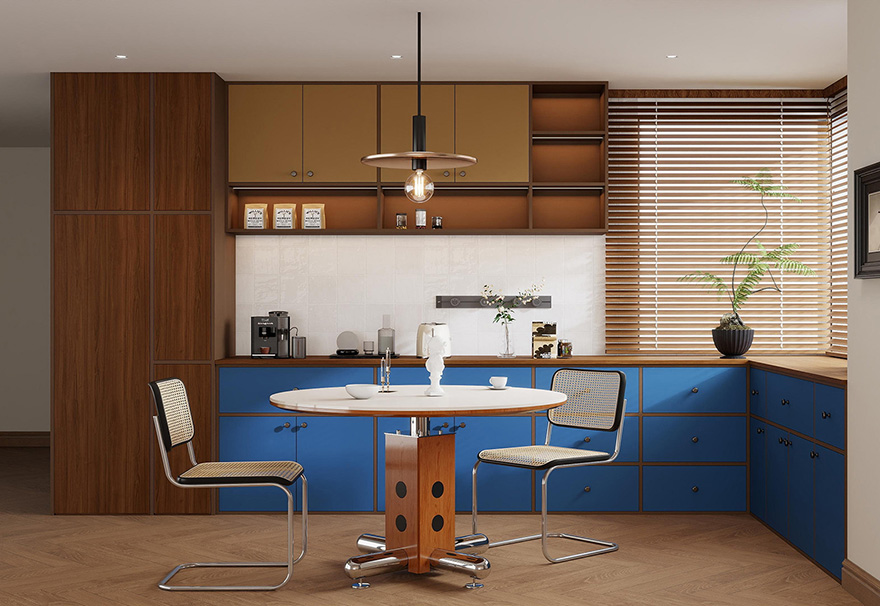
You go to a custom home store and the sales quote is "799 per projection area". Do you think it's cheap. When you actually place an order, you will find that the final price is significantly higher than your budget. Where is the problem? In terms of pricing method. Projection area and unfolding area are two completely different algorithms. The projected area is the length multiplied by the height when viewed from the front of the cabinet. It is simple and rough, and looks cheap. But it only includes the most basic configuration - usually only a few partitions, no drawers, no handles, no visible panels, and no non-standard size processing fees. Anything you want to add will be charged separately. The unfolded area is calculated by disassembling each panel of the cabinet, and the length is
The board industry has a characteristic: consumers can hardly verify the true quality of the product when purchasing. You can't see the inside of the substrate, you can't feel the quality of the glue, and you can't smell the level of formaldehyde. The serious asymmetry of information has made this industry a major disaster area for "pitfalls".
The first pitfall: brand mixing, selling miscellaneous goods under the name of a big brand.
If you come across a board from a well-known brand in the market and find it reliable, feel free to place your order. But what you don't know is that this brand may only produce substrates, and the finishing and processing are outsourced to small factories; Or this brand has over a dozen series, and what you're buying happens to be the worst one.
More hidden
Many people believe that the lifespan of the board depends on its quality. Is ENF grade board necessarily more durable than E0 grade? Are imported boards necessarily more durable than domestically produced boards? No. The lifespan of the board is 70% determined by the areas you cannot see. The first place that cannot be seen: hardware. Hinges, slides, handles, and connectors - these are the components that the cabinet is subjected to every day. No matter how good the board is, the hinge will loosen after two years of use, and the door panel will still sag and not close tightly. Many people spend a lot of money choosing boards, but save money on hardware, which is putting the cart before the horse. Good hardware can keep cabinets used for five to ten more years, while poor hardware can be scrapped in two years. The second one that cannot be seen
The customized cabinet has been in use for a year, but the door panel has warped; The kitchen hanging cabinet has been stored for two years, and the shelves are bent; The bottom of the bathroom cabinet has become moldy and blackened. Almost every family has encountered these problems, but few truly understand the reasons behind them. The first reaction of most people is that the quality of the board is poor, but the truth is often not that simple. Problem 1: The deformation of the board may not necessarily be caused by the pot made of the board. The first major culprit of sheet metal deformation is actually installation. No matter how good the board is, if there are not enough expansion joints reserved during installation, stress will be released when encountering humidity changes, manifested as bending, warping, and cracking. Especially at the border between the north and south, or in environments with underfloor heating
When buying boards, you spend a lot of time researching environmental grades, substrate types, patterns and textures, but you most likely overlook one thing - edge banding. In fact, edge sealing is the key to determining how long the board can last. Many cabinets have problems after two or three years of use, not because the boards themselves are not good, but because the edges have collapsed first. What exactly is border sealing preventing? Three things: waterproof, moisture-proof, and formaldehyde locking. The interior of the substrate of the board is like a sponge, and once water vapor seeps in from the edges, it will expand, mold, and layer. And a large part of formaldehyde release comes from the cross-section and gaps. Edge banding is to put a layer of armor on the board and remove everything